Skip to content
Hag
Chapter

Hag

The standing stones of ancient times are the subject of many tales told among the rural folk who live nearby. While travelling across the county of Gloucester I came upon a typical example in the tale of Old Meg. The gray and weathered stone, not quite the height of a man and a little broader, stands on a valley side near the village of Annonsbury, and is held by the local people to be the body of a pagan witch, who was turned to stone through the prayers of Saint Birinus during his mission of conversion in these parts.

— William Stukeley, June 1724

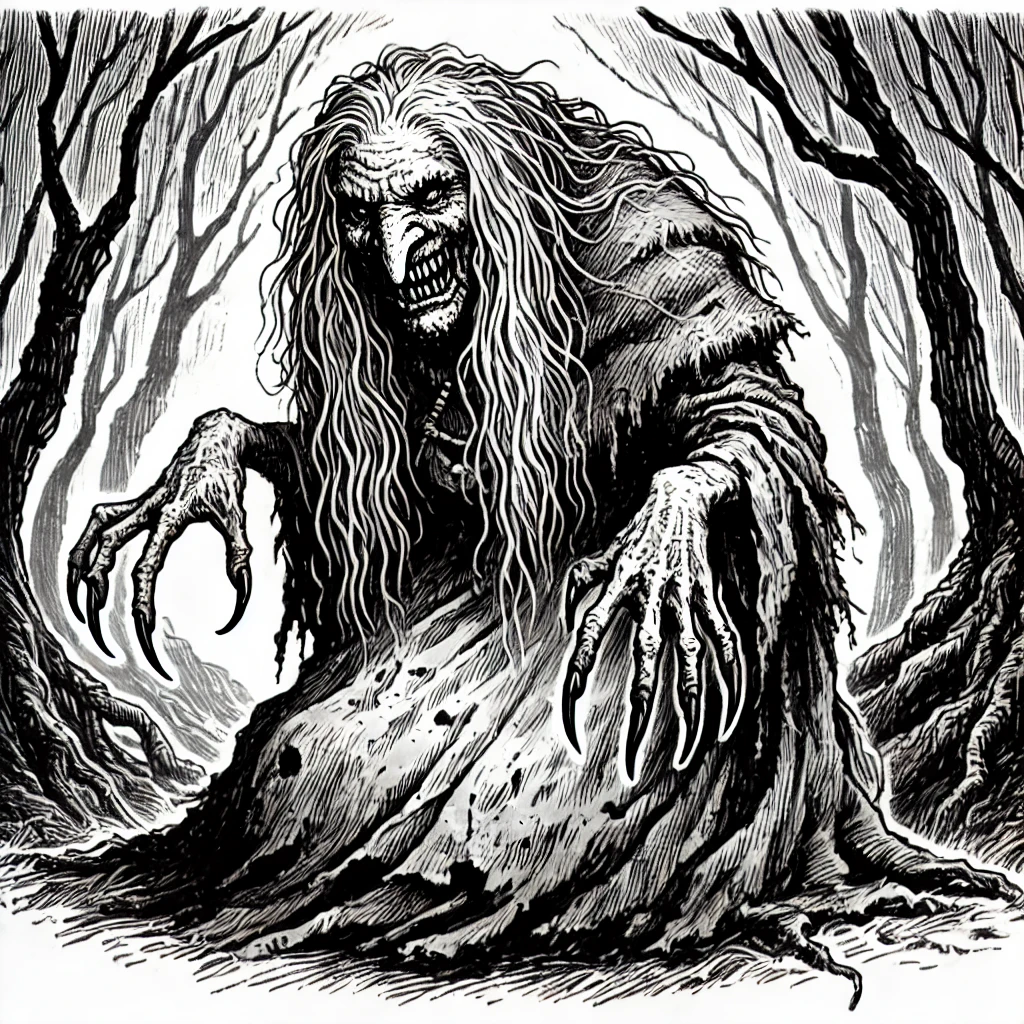
Hags have the appearance of old, ugly women whose faces are twisted into masks of rage. Their clothes are often ragged, their teeth are sharp, and their fingernails have grown into iron-­hard claws. There are many theories regarding their origins. Some say they are female trolls or ogres, smaller, more intelligent, but no less malignant. In some tales, their sons are all ogres and their daughters are all hags. Others believe that they are witches whose dealings with the powers of evil have transformed them into a barely-­human form, while others still regard them as fallen demi-­goddesses, fragments of the ancient earth-­mother whose worship was supplanted in ancient times by the rise of the weather-­controlling sky-­father as farming took over from hunting and gathering. Hags usually live in remote, forbidding places such as caves and deep woods. Some live underwater in dismal pools or deep rivers. They may be encountered at night or in bad weather, attacking lone travelers or stealing children to eat.

Ritual

Certain herbs, placed above windows and doorways, can prevent a hag from entering a building or room. These include sprigs of rowan, St. John’s wort, and four-leaf clovers. Cold iron, such as a horseshoe, placed above a door or window has the same effect. ◆ St. Merren’s School has recently welcomed its first class of boys to the idyllic Derbyshire countryside. The building was constructed near a river, where swimming and boating are encouraged – but several boys have gone missing, to the dismay of their wealthy parents and the embarrassment of the school. The authorities, including experts from Scotland Yard, are combing the area without success. No one pays any attention to local legends about a dangerous spirit inhabiting the river. ◆ The village of Amberforth is facing ruin. Spring somehow failed to come in this remote corner of England, leaving the frozen ground too hard to plow and the newborn lambs and calves freezing to death. A local hag has been angered somehow, and is punishing her mortal neighbors with an everlasting winter. ◆ The village of Broadfleet has become home to a thriving colony of artists, writers, and other bohemian types. Many are dabbling in occultism, and a small group has begun researching ancient pagan goddesses and attempting to reconstruct their worship. A local hag, diminished since the coming of Christianity twelve centuries ago, has made contact with the budding cult. She is careful to keep her true nature secret as she guides the mortals toward establishing the germ of a cult, in the hope of growing it until she regains her former power. The cailleach bheur (pronounced kall-­yach vair, approximately) from Scotland, Ireland, and the Isle of Man is a personification of winter, with a blue face and a skinny, starveling figure. She can call up bad weather at will. They were once weather goddesses, but are now diminished by the spread of Christianity. They are ruled by a one-­eyed giantess named Beira, who claims the title Queen of Winter. Black Annis, from Leicestershire, has a blue face and iron claws in place of nails, with which she can dig a cave from solid rock to shelter in. She waits in ambush to seize and devour passing children and lambs, for their meat is the tenderest. Jenny Greenteeth from Lancashire and Peg Powler from the River Tees lurk underwater and drag careless children to their deaths in deeper water. The Fad Felen of Gwynedd in Wales was sent as a punishment for the sins of the people. She might appear anywhere on the same errand. She has gray skin and her hair, teeth, and eyes are all yellow. She walks with a hunched gait, and her hands are armed with claws as hard as iron. Her name means “yellow pestilence” and her breath carries the plague.

Ask your Gamemaster

Click to reveal if permitted