Chapter
Leprechaun
That morning one of my host’s tenants begged the favour of an audience, and I heard afterward that he had come into enough money to buy out his lease and take ownership of his cottage and its land as a freeholder. The locals were at a loss to account for his sudden prosperity. Some muttered that the coin was somehow ill-gotten, though never in the man’s hearing. Others, older or after an evening’s drinking, whispered that he had got the better of a leprechaun, although they were careful to avoid naming the creature, using the formula “the little shoemaker” to evade the wrath of the fairy folk.
— William Stukeley, September 1712
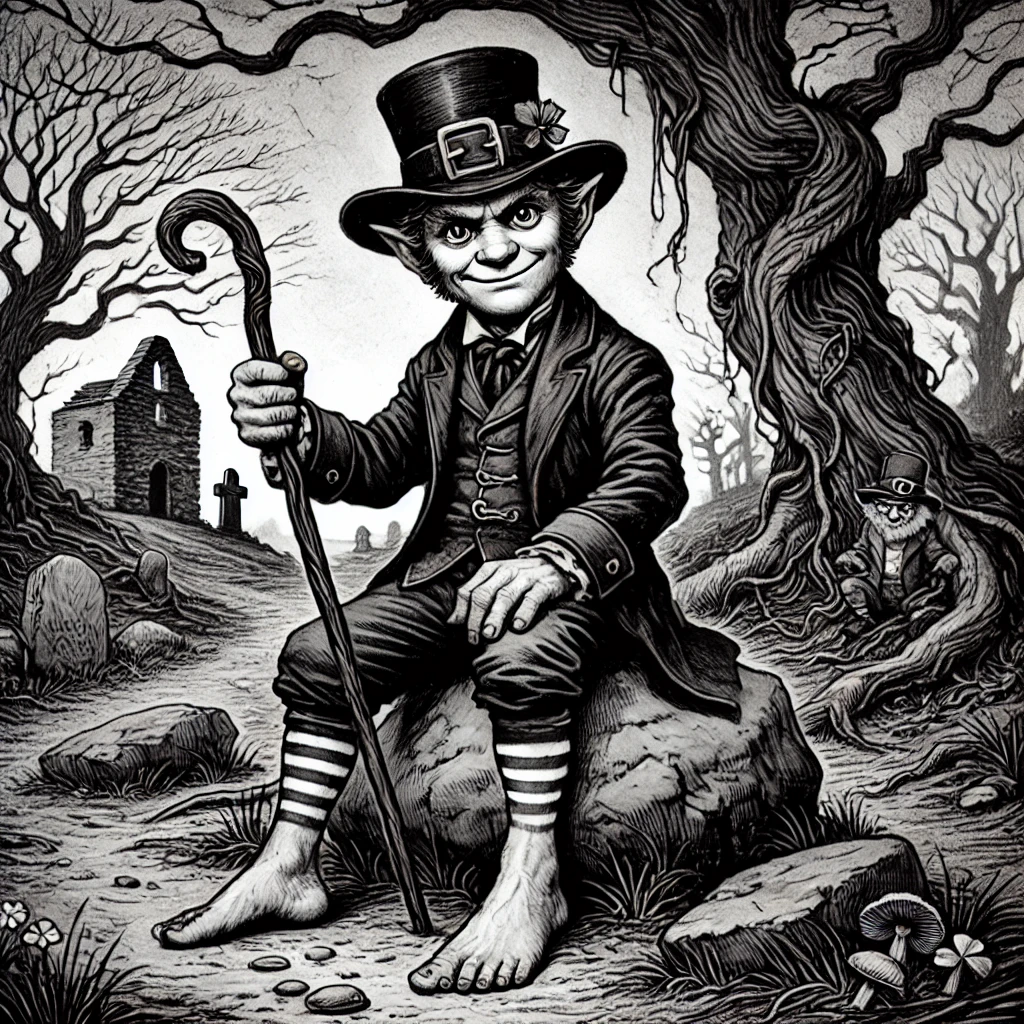
Leprechauns are the shoemakers of the fairy folk, and on the rare occasions when a mortal encounters one he is usually working on a small shoe for some fairy dignitary. They look like small humans, a foot or two tall, and wear fine shoes with bright buckles. They are incorrigible tricksters and spinners of yarns, and delight in misleading, embarrassing, and defrauding mortals. A leprechaun knows the location of every buried treasure in his home area, and it is said that anyone who can catch and hold him can force him to tell where treasure can be found. However, leprechauns are cunning enough to lie their way out of most situations, and can wield a heavy walking-stick called a shillelagh to good effect. If captured, a leprechaun will try to pull out his snuff-box and throw or blow its contents in his captor’s face, escaping while the unlucky mortal is sneezing helplessly.